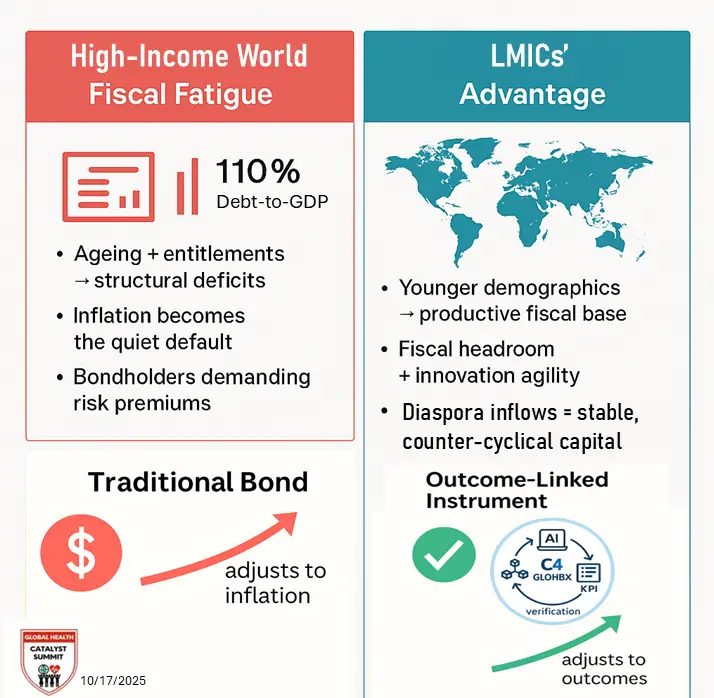
The Economist’s October 13th special report paints a sobering picture: advanced economies now carry debt exceeding 110% of GDP, spend more on interest than defense, and quietly “default” through inflation.
Governments can’t easily raise taxes or cut spending — politics and ageing populations make reform almost impossible.
But there’s another story — one unfolding across Low-and-Middle Income Countries (LMICs). Younger demographics. Fiscal headroom. Rising digital infrastructure. And a growing wave of diaspora capital.
While high-income countries struggle under entitlement fatigue, LMICs can redefine what credibility means — not by borrowing more, but by verifying more.
The Global Health Bond Exchange (GLOHBX), operated by Global Health Catalyst, is pioneering a transparent marketplace that treats health as the greatest wealth, where every dollar — from diaspora bonds to philanthropic vouchers — is verified by AI, anchored on blockchain, and guaranteed by measurable outcomes.
Instead of adjusting to inflation, GLOHBX instruments adjust to impact — paying for verified health and social results.
It’s fiscal discipline redefined for the 21st century: trust built on data, not promises.
If the 20th century’s fiscal model was “borrow now, justify later,” the next one must be “verify first, then invest.”
#DiasporaHealthFinance #ImpactFinance #BlendedFinance