Insights from The Economist, Nov 20, 2025
Africa enters the first G20 hosted on its soil with a financial landscape reshaped by forces far more complex than the headline-grabbing clashes over external debt. New analysis shows a transformation unfolding quietly but decisively: domestic borrowing, not foreign loans, is now driving Africa’s most dangerous debt crisis.
This shift has profound implications for development, fiscal stability, and health financing. And it makes one thing abundantly clear:
Africa cannot keep borrowing its way to development. It needs new, performance-based financing models.
GLOHBX—through blended capital, guarantees, diaspora participation, and verified health outcomes—is designed precisely for this moment.
1. Africa’s Silent Crisis: Domestic Debt Has Overtaken External Debt Growth
The Kiel Institute’s new African Debt Database documents the scale of the shift:
- Domestic debt has surged from $150bn in 2010 to nearly $500bn in 2024 – a growth rate exceeding all external sources combined.
- Around half of all government debt in sub-Saharan Africa is now domestic.
- Countries shut out of Eurobond markets—Ghana, Mozambique, Kenya—are relying heavily on short-term domestic borrowing at extremely high interest rates.
- In 2025, Kenya will meet two-thirds of its financing needs from domestic markets.
This is creating a structural trap: rising rates, shorter maturities, financial repression risk, and massive exposure concentrated among domestic banks.
What it means:
Africa’s debt problem is no longer about China or Western lenders.
It is about domestic fragility and the need for non-debt capital.
This is the environment GLOHBX was built for.
2. Debt Is Crowding Out Health, Education, and Growth
The findings are stark:
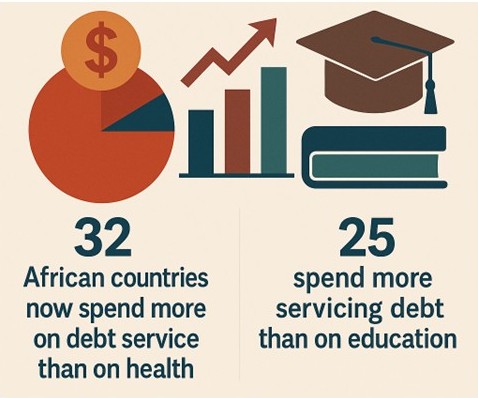
- 32 African countries now spend more on debt service than on health,
- 25 spend more servicing debt than on education.
Former South African finance minister Trevor Manuel calls it “defaulting on development.”
What it means:
Traditional fiscal space is gone. Health systems cannot rely on tax-funded expansion or concessional loans. Governments need financing that:
- does not create new debt,
- does not expand sovereign obligations,
- does not crowd out private sector credit,
- and does not erode bank balance sheets.
This is exactly the design of GLOHBX’s outcome-linked health financing.
3. Traditional Debt Relief Is No Longer Coming
The 2005 G8-style wave of debt cancellation will not return.
Today:
- Private creditors hold 43% of Africa’s external debt.
- Multilaterals hold 34%.
- China prefers repayment delays, not forgiveness.
- The G20’s Common Framework delivered only 7% Net Present Value relief on average.
- Major Western powers are politically disengaged from this G20 cycle.
What it means:
Africa is “on its own” in restructuring debt and finding new capital sources.
The continent must build its own financing mechanisms—resilient to geopolitics, elections, or interest-rate cycles.
GLOHBX is exactly such an Africa-anchored mechanism.
4. Domestic Debt Is Now a Systemic Financial Stability Threat
The IMF warns that:
- African banks hold 20%+ of their assets in government debt—double the share of 2010.
- Inflation risks can create negative real returns, eroding bank capital.
- Excess sovereign borrowing crowds out private credit needed for growth.
This means the classic approach – “borrow domestically to fill the gap” – is now a threat to banks, jobs, and economic recovery.
What it means for GLOHBX:
Platforms like AHBX/GLOHBX reduce sovereign reliance on debt by:
- attracting diaspora flows,
- mobilizing philanthropic first-loss and Corporate Social Responsibility capital,
- leveraging Development Finance Institution guarantees,
- tying government payments only to verified outcomes,
- and capping payments within government ceilings.
This protects domestic banks and creates new capital inflows without new borrowing.
5. The Opportunity: Build Africa’s First Performance-Based Capital Market
The article ends on a crucial insight:
Domestic markets can become engines of prosperity—if the continent breaks free from short-term, high-cost borrowing.
This is where GLOHBX fits as a structural solution:
- It transforms health outcomes into an investable asset class.
- It introduces long-duration, guarantee-enhanced instruments.
- It builds Africa’s first dedicated performance-financing marketplace.
- It integrates African data, African verification, and African budgeting systems.
- It aligns with the growing AfCFTA vision of continental capital market deepening.
GLOHBX is not simply a financing model.
It is the financial architecture Africa has needed for a decade.
Conclusion
Africa’s debt crisis is evolving faster than the global system can respond.
External relief is limited. Domestic debt is exploding. Banks are exposed. Health budgets are collapsing.
In this environment, countries need:
- non-debt capital,
- predictable financing,
- guarantee-backed investment,
- diaspora participation,
- verified results,
- and fiscal neutrality.
This is precisely what GLOHBX provides.
Africa doesn’t only need debt restructuring.
It needs a new, evidence-driven financial engine.
GLOHBX is that engine.