
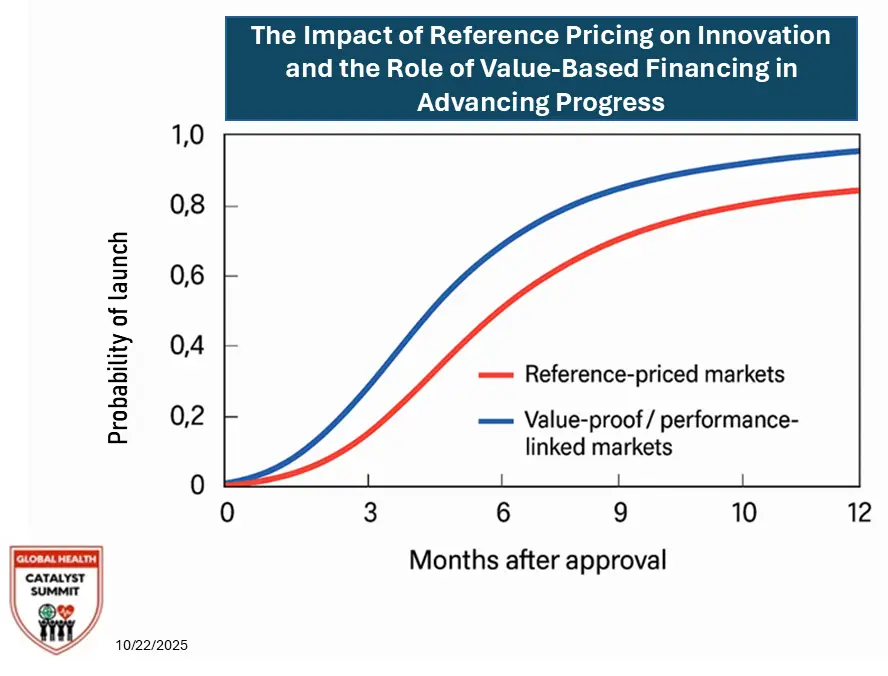
Across Europe, evidence shows that linking drug prices to the lowest in other countries—known as external reference pricing—can unintentionally delay access to new medicines in lower-income markets.
In the USA, the drug pricing policy debate is a complex balancing act between affordability, innovation, finance model, and global dynamics. If reference-pricing rules are applied to America, they’d do little to cut prices — but would slow access globally.
A study by Luca Maini (2020) found that reference pricing accounted for over half of all drug-launch delays across 27 European countries, often extending access lags by 6–12 months in poorer markets.
A more recent global analysis by Vokinger et al. (2023) confirmed the pattern: countries subject to reference pricing were 73 percent less likely to see a new drug launched within nine months of approval.
When high-income markets tie their prices to the lowest elsewhere, pharmaceutical firms delay launching in those “reference” markets to avoid eroding global price benchmarks. The result: delayed innovation for those who need it most.
GLOHBX offers a different path.
By replacing price-peg logic with value-proof logic—through outcome-linked bonds, transparent blockchain registries, and diaspora-backed co-investment—LMICs can become first movers in financing innovation based on verified impact rather than arbitrary benchmarks.
“Europe’s price-peg delayed access for LMICs. GLOHBX builds the value floor that brings innovation forward.”
Evidence Insight · October 2025 · Sources: Maini (2020); Vokinger et al. (2023)
Next in this series: Price-Pegged vs Value-Proof Financial Markets