In today’s markets, trust has become more valuable than capital.
From New York to Nairobi, investors are realizing that money alone doesn’t guarantee stability — verification does.
When markets get shaky, people move their money into “safe yields” — assets that hold value even when others fall. Traditionally, that meant U.S. bonds or blue-chip stocks. But as recent crises show, even these can wobble when credit systems rely on opacity, speculation, and delayed data.
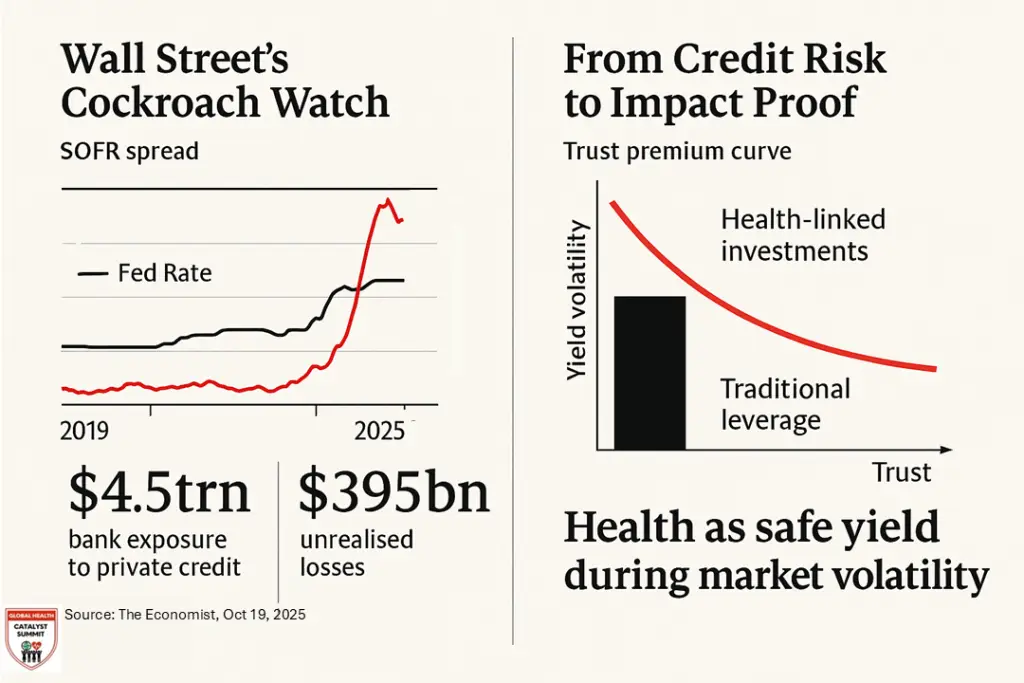
That’s where the Trust Premium Curve comes in.
1. At the High-Risk End — Opaque Credit
This is where traditional leverage sits.
Banks and private funds lend into complex webs of borrowers, often with limited visibility. When interest rates rise or one link breaks, uncertainty spreads fast.
In these systems, the less investors know, the higher the risk premium they demand — which makes credit costlier and less inclusive for developing economies.
2. At the Low-Risk End — Verified Impact
Now imagine the opposite:
Every dollar invested is tied to proof of outcome — a diagnostic center that’s operational, a health worker retained, a rural clinic connected.
AI and blockchain can track these outcomes in real time. When performance is visible and verifiable, trust replaces speculation.
This creates a “Trust Premium” — where investors accept lower volatility and stable returns because the underlying asset is real, social, and data-proven.
3. What This Means for LMIC Policymakers and Investors
LMICs can move from being perceived as “high-risk” borrowers to being high-trust partners, by embedding verification into every transaction.
That’s what platforms like GLOHBX aim to do — turning health outcomes into investable, trackable, and tradable value.
- For policymakers: Verified outcomes attract guarantees and concessional co-investment.
- For investors: Verified outcomes de-risk exposure and open new blended-finance pipelines.
- For citizens: Verified outcomes ensure that capital translates into actual care.
The Bottom Line
The future of finance isn’t about chasing yield — it’s about earning trust.
The Trust Premium Curve shows that verification lowers volatility, builds investor confidence, and turns social impact into a new class of safe assets.
Health investments that deliver proof, not promises, are no longer just moral wins — they’re macro-stabilizers.
SOFR stands for Secured Overnight Financing Rate.
It’s the benchmark interest rate that replaced LIBOR (London Interbank Offered Rate) in the United States.
- What it measures:
The average cost at which banks and large financial institutions borrow cash overnight using U.S. Treasury securities as collateral. - Why it matters:
It’s considered a “risk-free” rate, because it’s based on actual secured transactions (not estimates), and it reflects real demand for liquidity in the U.S. financial system. - Why investors watch it:
A rise in SOFR means banks are becoming more cautious or need more cash — a sign of tightening liquidity or financial stress (as seen in the article you shared).
In short: SOFR = the heartbeat of dollar liquidity. When it jumps, it’s a signal that financial arteries are tightening.