March 9, 2026
What J.P. Morgan’s March 9, 2026 Weekly Market Recap implies for GLOHBX
J.P. Morgan’s latest weekly market recap reads like a stress test for the global economy: escalating conflict risk in the Middle East, a threatened energy supply shock, and renewed inflation pressure—all landing on consumers already stretched. For GLOHBX, the memo is a useful signal: in a world of geopolitical shocks and inflation sensitivity, capital and governments will increasingly favor disciplined, verifiable, income-like investments—and will need financing models that protect social sectors without blowing out budgets.
1) Energy shocks hit the poorest first—and health absorbs the downstream damage
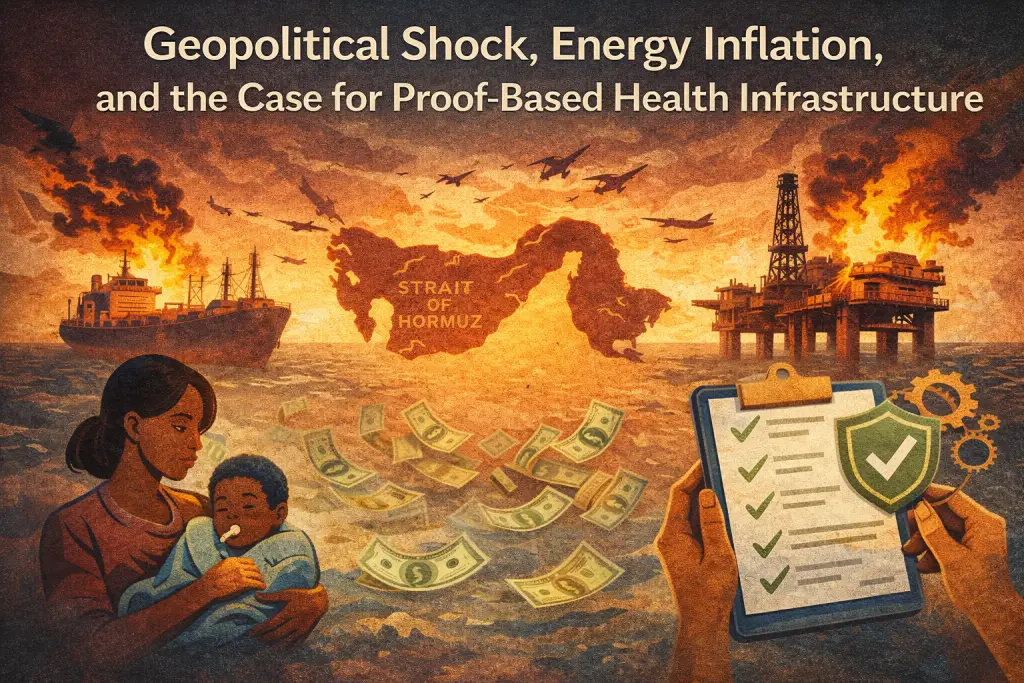
The recap highlights the potential closure of the Strait of Hormuz, a critical transit route for a large share of global oil and LNG flows, raising the risk of a sustained energy-price spike.
Its “Chart of the Week” underscores the distributional impact: energy costs consume a much larger share of income for lower-income households, reinforcing a “K-shaped” economy.
When energy prices surge, households delay care, skip screenings, and face higher catastrophic health spending, especially in settings with high out-of-pocket costs. That makes health outcomes more volatile precisely when public budgets are tight.
GLOHBX response: build shock-resilient protection rails: vouchers, targeted subsidies, and verified Key Performance Indicators so resources reach patients with minimal leakage.
2) Inflation risk rises faster than growth risk—making ceilings + proof more valuable
J.P. Morgan notes that higher oil prices would likely affect inflation more than growth (particularly in the U.S.), because producers benefit while consumers suffer.
In inflationary regimes, ministries of finance and investors become allergic to open-ended commitments.
GLOHBX response: this is exactly why the platform’s architecture matters:
- price ceilings per verified outcome (downside bounded)
- accepted-only evidence rules (payability discipline)
- custody + settlement gating (controlled disbursement)
In short: inflation is a forcing function for fiscal discipline—and GLOHBX is a fiscal-discipline product.
3) Markets are explicitly rotating toward “real assets + income”
The memo makes the portfolio implication clear: the shock “underscores the need for diversification,” and notes that real assets and income-producing investments can provide balance in uncertain periods.
GLOHBX response: position outcome-linked health financing as investable real-economy infrastructure:
- diagnostic uptime and maintenance
- screening throughput and early detection
- chronic disease continuity
- workforce stability
These are measurable services that become financeable when verification is strong—moving health from “social spending” to “infrastructure-like performance.”
4) Slowing demand signals tighten fiscal space
The recap also points to softening demand data (payroll and retail sales) while key inflation readings remain ahead.
This is the squeeze governments fear most: slower growth plus inflation risk.
GLOHBX response: blended, proof-based financing becomes more necessary:
- Philanthropy capital absorbs early risk
- diaspora capital serves as a catalyst for broader capital
- guarantees restore affordability
- pay only after verified delivery, within approved ceilings
This model scales impact without expanding sovereign debt exposure.
Lessons from this week’s macro signal
This market recap is not about Low-and-middle income countries or health. Yet it reinforces the logic behind GLOHBX:
- Volatility increases the value of rules, proof, and settlement discipline.
- Energy inflation widens inequality, increasing the need for targeted, auditable health protection.
Bottom line: In a shock-prone world, “trust-me financing” breaks. Proof-based financing strengthens. GLOHBX is designed to make health systems investable precisely when macro conditions make discipline non-negotiable.